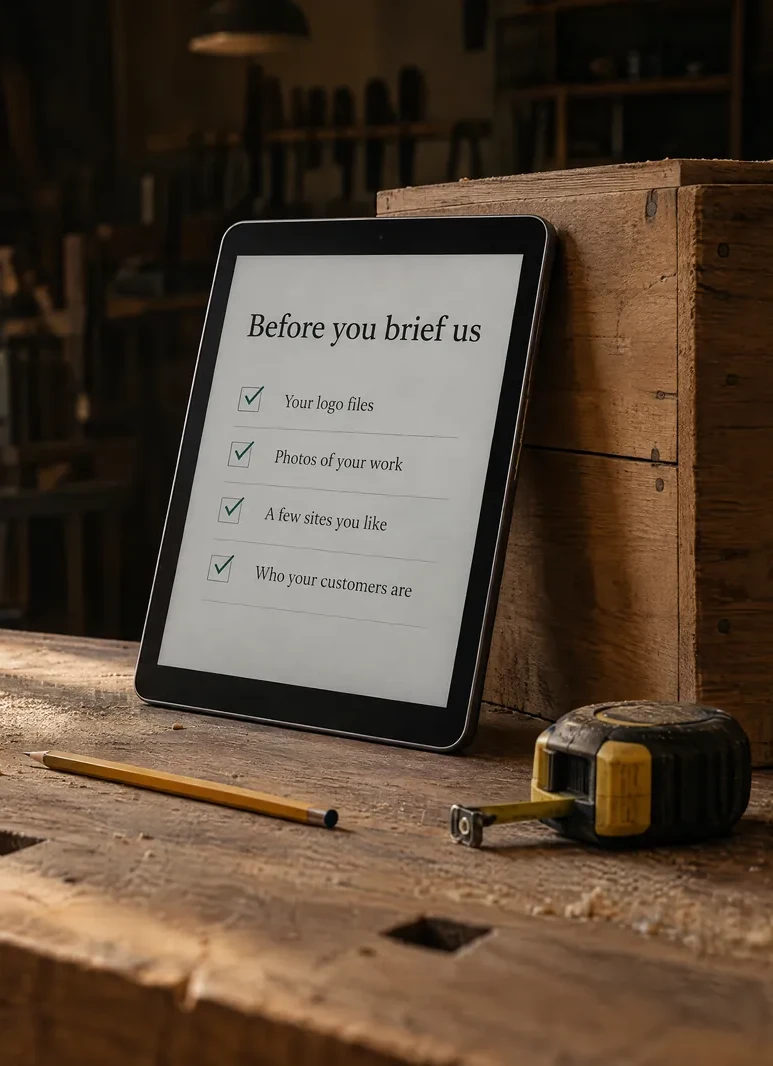


Before you hire a web designer, have these ready: a clear goal for the site, your text, your photos and logo, a few websites you like, your colours and fonts, the name of the person who'll make decisions, a budget and a realistic timeline. None of it needs to be polished. A website can only move as fast as its content arrives, so the more you gather now, the more smoothly the project runs.
A goal you can say in one sentence
Start with what the site is for. Bringing in quote requests, taking bookings, selling products online, or reassuring people who've already heard of you and want to check you're real? Pick the one that matters most. It decides what goes on the homepage, what the main button says and how you'll judge whether the site is working.
It also helps to jot down:
- who your best customers are, and what they ask before they buy
- the three or four services or products you most want to sell
- a few competitors, and what you'd like to do differently from them
- anything about your current website that annoys you or your customers
Your words
Your text matters more than almost anything else in the build, and nobody knows your business as well as you do. Start with:
- what you do, who for and where
- each service or product, with what's included and, if you're happy to share them, prices
- the questions customers ask most often, with your answers
- a short piece about you or your team
- contact details, opening hours and the areas you cover
Rough notes are fine. A designer or copywriter can tighten them up, but they can't invent what only you know.
If you have genuine reviews from customers, gather those too, with permission to use their names. Reviews that mention a result — the job finished on time, the problem solved — carry more weight than general praise.
Photos and your logo
Gather real photos of your work, your premises, your products and your people. Send the original files at full size, not screenshots or images saved from social media, which are usually compressed and too small for a large screen. If you don't have enough good photos, say so early. It's much easier to plan a shoot at the start than halfway through.
For your logo, the best file is a vector — SVG, EPS, AI or PDF — because it stays sharp at any size. A PNG with a transparent background is the next best thing. If all you can find is a small JPEG from your email signature, tell your designer. It may need redrawing, and it's better to know that on day one.
Sites you like, and your colours and fonts
Find three to five websites you like, from any industry, with a line on what you like about each: the photos, the layout, how easy it is to find a price. A site you dislike, and why, is just as useful. "I like this" gives your designer a direction. "I like this because the prices are right there" gives them something to work with.
If you have brand guidelines, send them. If not, send your brand colours — the exact codes if you have them, such as a hex code like #1F3A5F — and the names of any fonts used on your signs, vans or printed material. If none of that exists yet, that's fine. Say so, and it can be planned in rather than discovered halfway through.
Who decides, what you'll spend and when you need it
Who decides. Name one person who gives feedback and signs things off. Projects stall when feedback arrives from several people who disagree, or when the person with the final say only sees the site at the end. If others need a say, collect their comments and send one set of notes.
Budget. Have a figure in mind, even a range. It isn't there to be squeezed. It tells the designer what's realistic: how many pages, whether you need a shop or online booking, whether you'll be able to edit the site yourself. Think about running costs too — hosting, the domain and any monthly support. Ask for the price to be fixed and agreed in writing before work starts, and check whether VAT is added on top.
Timeline. If there's a date that matters, such as a launch, a busy season or an event, say so at the start. Then work backwards from it. Even a short build is only short if your content is ready and your feedback comes back promptly.
Logins. Finally, find the logins for your domain, your current website and hosting, your Google Business Profile and any analytics. Hunting for a forgotten password on launch day is avoidable.
Where we come in
From you, we need your text, photos and logo, plus sites you like and your colours and fonts. Once everything is in and your feedback comes back within 3 working days, an Essential site is live in 5 working days from the start date and a Signature site in 10, at a fixed price agreed in writing. No VAT is charged. See how we work for the full process.