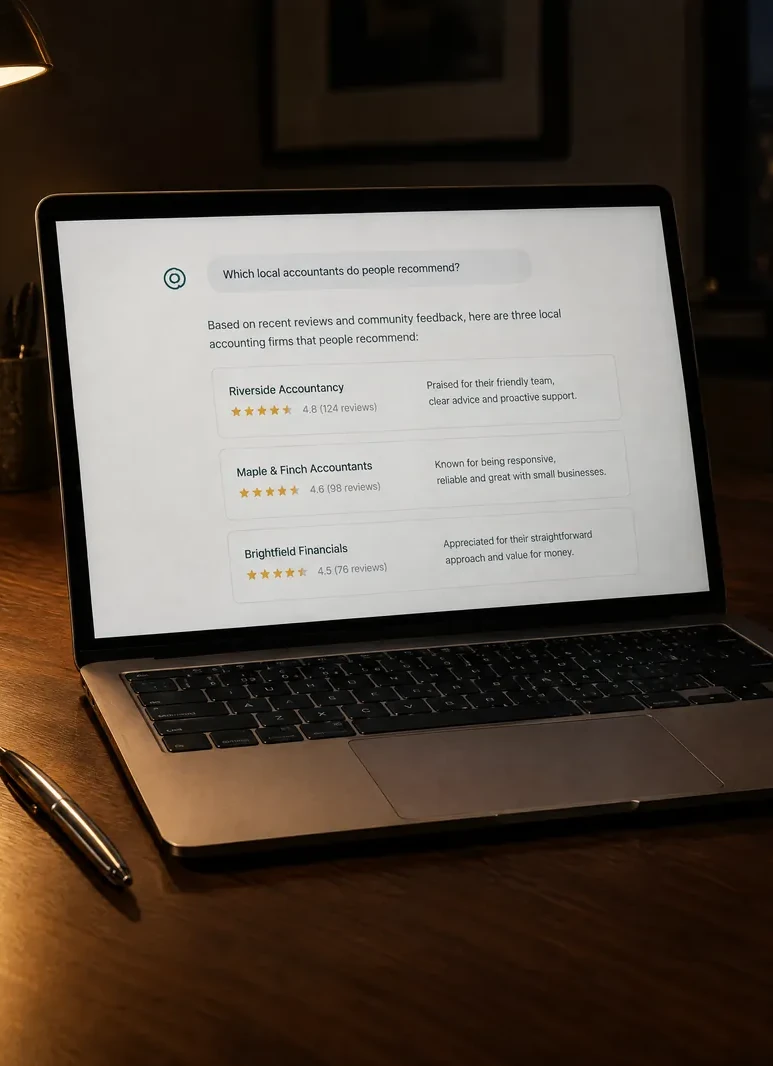


Nobody outside OpenAI and Google knows exactly how ChatGPT or Google's AI Overviews decide which businesses to name. What is known is that they build answers from sources they can read and trust, so a business with clear, consistent, well-described information across the web gives them more to work with. You can't control what they say, but you can make your business easy to understand and easy to quote.
Where the answers come from
Ask one of these tools for "a dog groomer in Lincoln" and it has two broad ways to answer. Some of what it says comes from what the underlying model learned during training. Increasingly, these tools also run a live web search and summarise the pages they find, often with links to their sources. Google's AI Overviews sit on top of Google Search, so they draw on pages Google has already found and indexed.
Either way, the tool can only work with what it can find and read. If your services, location and prices are vague, scattered or contradictory, there's less for it to go on, and a business with clearer details may be named instead.
How these systems weigh one source against another isn't public, and it changes. Anyone promising you a place in AI answers is guessing.
Make your business easy to understand
Start with your own website, because it's the source you control.
- One clear page per service. A page called "Boiler servicing" that says what's included, who it's for, the area you cover and a starting price is easier to understand than one page listing everything you do.
- Say where you work. Name the towns and areas you serve in plain text. If customers come to you, put the full address on the site.
- Keep key facts in the page text. Information locked inside images, PDFs or pop-ups is harder for any tool to read. Check, too, that your site isn't blocking search engines from crawling it.
- Add structured data. This is a small block of code, invisible to visitors, that labels facts in a format machines can read reliably: your business name, address, phone number, opening hours and services. It follows a shared vocabulary, schema.org, that the major search engines support. It doesn't guarantee anything, but it removes guesswork.
Keep your details the same everywhere
AI tools don't only read your website. They may also come across your Google Business Profile, directory listings, social media pages, local news and other sites that mention you.
When those sources agree, with the same name, address, phone number, hours and description of what you do, they back each other up. When they disagree, it's harder for anyone, person or machine, to tell which version is right.
A useful afternoon's job: search for your business name, list every place it appears, and correct anything out of date. Old phone numbers, a previous address and opening hours from before you changed them are common culprits.
Reviews and content worth quoting
Reviews are part of the public record about your business, and they're among the sources these tools can read. Specific reviews carry more information than vague ones. "Fixed our boiler the same day in Cleethorpes" tells a reader, and a machine, what you do and where. "Great service" doesn't. You can't write reviews for customers, but you can ask every one of them, and reply to reviews in a way that adds useful detail.
Then write your own pages so they can be lifted straight into an answer:
- Answer first. Put the direct answer to a question in the first sentence or two, then explain.
- Use the questions people actually ask. Your phone calls and emails are the best source. "Do you work weekends?" "How long does a full service take?" Write them down and answer them on the page.
- Be specific. Prices or price ranges, timescales, areas covered, what's included. A specific statement is easier to quote than a general claim about quality.
How to check where you stand
Ask the tools yourself. Type the questions a customer would: what you do and where you are, phrased a few different ways. Note which businesses are named and which sources are linked.
Treat the results as a snapshot, not a score. Answers can vary with the wording, the location, the day and the person asking. Check every month or two and look for patterns rather than single answers. If the same competitor keeps appearing, look at what their site and listings do that yours don't.
Nobody can honestly promise that you'll be recommended. What you can do is remove every reason for a tool to misunderstand you.
Where we come in
Our GEO work covers the groundwork in this post: clean site structure, structured data and content written to be quoted. Our Growth and Scale plans carry on with SEO, GEO and AEO every month. See how it fits with the rest of our search work.